
PVC vs Steel Well Casing Yuma
You only drill a water well once. Do not bury cheap material in the aggressive, high-salinity soil of Yuma County and expect it to survive the desert.
Discuss Casing Options & Pricing
Direct terminal to engineering. Schedule 80 PVC vs Carbon Steel analysis.
The Autopsy of a Failed Pipe
Your water develops a sharp, metallic bite overnight. A week later, your whole-house filter housings are packed thick with heavy red rust and sharp flakes of black scale. Finally, you turn the tap and get nothing but a violent hiss of air followed by a slurry of thick, brown mud. Out at the pump house, the submersible motor is screaming as it chokes to death on sediment. This is the exact mechanical autopsy of a failed steel well casing.
The pipe separating your clean drinking water from the raw native dirt is the most critical component of your entire infrastructure. If that pipe breaches, the well dies. In Yuma, AZ 85364, the geology actively fights metal. The aquifers in the Colorado River basin, heavily fed by centuries of agricultural runoff and mineral deposits, are loaded with high chlorides, extreme dissolved solids, and severe soil salinity. When weighing PVC vs steel well casing lifespan in this environment, you must factor in the aggressive chemical reality of the local dirt.
Electrochemical Destruction: Why Cheap Steel Rots
When you drop a column of cheap, thin-walled carbon steel into the Yuma Valley alluvium, it does not just sit there. It becomes a massive ground rod. The highly saline soil acts as a perfect liquid electrolyte. Natural stray voltages in the earth, combined with the electrical grounding of your own pump system, trigger a continuous process of galvanic corrosion. The steel casing literally acts as a sacrificial anode, dissolving its own iron molecules directly into the groundwater.
This is not a slow, gentle aging process. The metal oxidizes rapidly from the outside in. Standard black steel casings operating in aggressive soils typically only last 25 to 40 years before major structural degradation occurs. Pinhole leaks develop first, allowing oxidized iron bacteria to colonize the inside of your well screen. Eventually, the structural integrity of the steel completely rots away. The immense hydrostatic pressure of the earth violently crushes the weakened pipe, dumping tons of sand directly on top of your submersible pump, burying it forever. To avoid this catastrophic failure, we mandate the use of corrosion resistant well casing materials wherever the geology permits.
The Solution: Schedule 80 PVC Well Pipe
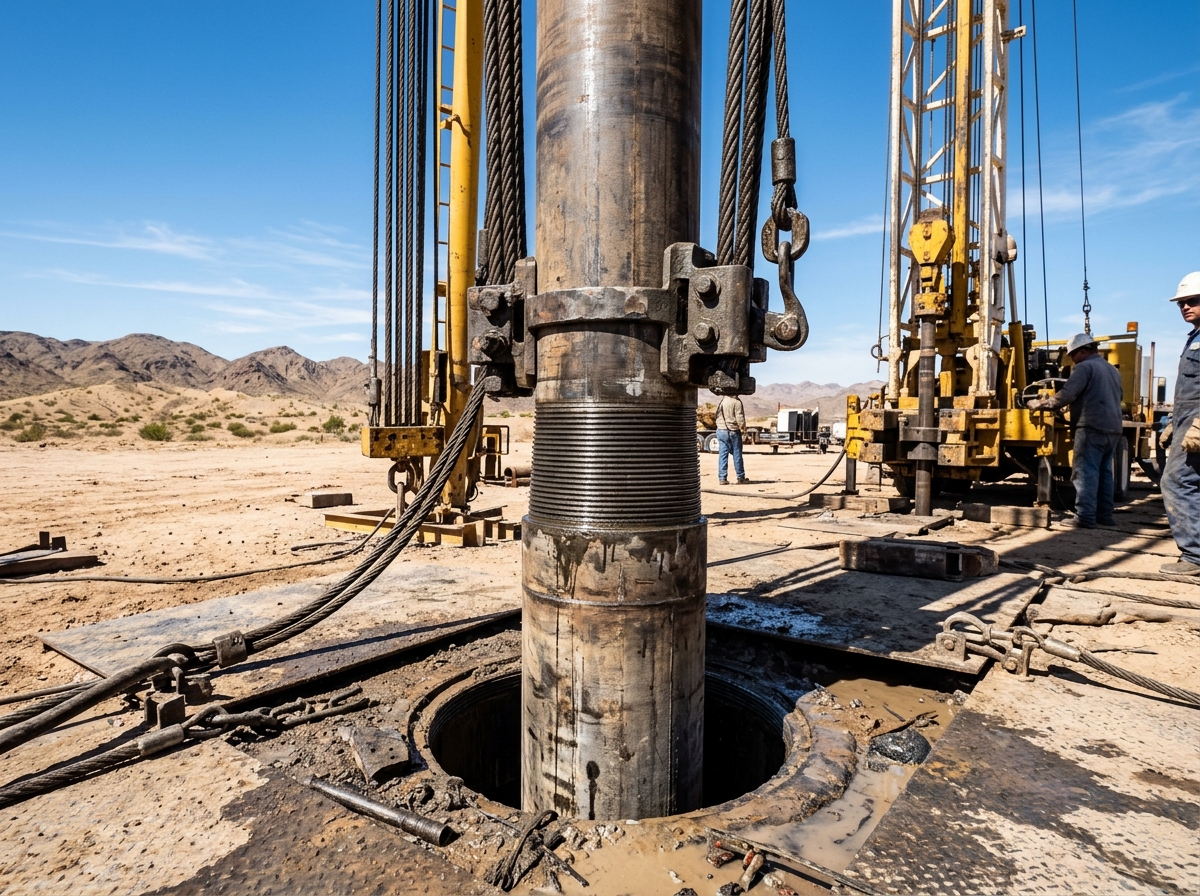
For the vast majority of residential and light agricultural drilling in the Yuma Valley and Fortuna Foothills, advanced polymer is the only logical choice. A properly installed PVC casing offers a lifespan of over 50 years, completely immune to the rust and corrosion that destroy steel.
We do not use thin, standard-issue hardware store plastic. We install industrial-grade Schedule 80 PVC well pipe or highly engineered SDR-17 (Standard Dimension Ratio) casing. Schedule 80 pipe features a massive wall thickness engineered to withstand extreme external crush pressures. Because PVC is a thermoplastic, it does not conduct electricity. It is entirely immune to galvanic corrosion, meaning it will never rust, pit, or leach metallic scale into your drinking water.
Furthermore, we do not glue downhole casing. Chemical solvents can contaminate the aquifer and fail under high tensile loads. We use precision-machined, flush-threaded PVC joints equipped with heavy-duty O-rings. We thread the casing string together mechanically as it drops into the borehole, ensuring a perfectly smooth, watertight seal from the surface down to the target aquifer.
Hydraulic Friction and Pumping Efficiency
PVC offers a significant mechanical advantage beyond corrosion resistance. The internal walls of a Schedule 80 PVC pipe are completely smooth, whereas steel pipe is rough and becomes heavily textured as scale builds up over the years.
When your submersible pump kicks on and pushes 35 Gallons Per Minute up the pipe, that water rubs against the casing walls. This creates hydraulic friction loss. The rougher the pipe, the harder the motor has to work to push the water to the surface. By utilizing perfectly smooth PVC, we drastically reduce friction loss. This allows your pump to operate at peak efficiency, drawing lower amperage, running cooler, and significantly extending the life of your electrical hardware.
When Steel Casing is Absolutely Mandatory

We are not anti-steel. We are anti-cheap steel used in the wrong geology. There are specific environments in Yuma County where PVC physically cannot survive the installation process or the operational depths.
If your property is situated high on the Yuma Mesa, we are regularly required to push drill bits past 400 to 600 feet to reach the groundwater mound. At these extreme depths, PVC hits its tensile limit. If you hang 600 feet of heavy PVC casing in a borehole, the sheer physical weight of the pipe string can cause the threaded joints at the top of the well to pull apart and snap. Furthermore, the Yuma Mesa consists of heavily cemented caliche and hard-pan rock. As the earth shifts over decades, the lateral pressure exerted by this solid rock can easily crack a plastic pipe.
For deep Mesa drilling, or for high-capacity 16-inch agricultural wells in Dome Valley, we must use heavy-wall carbon steel. When steel is mandatory, we over-engineer the string. We do not use thin-wall pipe; we specify 0.250-inch or 0.375-inch thick steel. We join the casing via full-penetration stick welding, ensuring the joints are stronger than the pipe itself.
Protecting the Iron: Centralizers and Annular Seals
If we must put steel in the ground, we have to protect it from the corrosive soil. We accomplish this through strict mechanical isolation. As we lower the welded steel string into the borehole, we attach heavy-duty stainless steel centralizers to the outside of the pipe. These centralizers act like leaf springs, keeping the steel pipe perfectly centered in the middle of the borehole.
Once the casing is set, we run a tremie pipe down the annular space—the void between the outside of the steel and the raw dirt wall of the borehole. We fire up our mud pumps and inject a continuous column of high-solids bentonite grout from the bottom up. This grout encases the entire steel pipe in a protective, impermeable barrier, locking the corrosive saline soil away from the metal and protecting the aquifer from surface contamination.
Make the Right Casing Investment
Do not let an amateur driller win a bid by undercutting the material costs and throwing thin-wall black steel into a corrosive, shallow valley aquifer. You will save a few dollars today, and you will pay $15,000 for a catastrophic casing collapse repair ten years from now. The casing is the one component of your water system that cannot be easily replaced. It must be built to survive the desert.
Call Yuma Water Well Drilling at (928) 248-8305. We will evaluate the precise hydrogeology of your parcel, analyze the soil salinity risk, and engineer the exact Schedule 80 PVC or heavy-wall steel casing required to secure your water supply for the next fifty years.
Flush-threaded Schedule 80 PVC, SDR-17 liners, and full-penetration welded 0.250-wall steel.
PVC vs Steel Casing FAQs
What is the PVC vs steel well casing lifespan?
In aggressive soil conditions, standard steel casing typically lasts 25 to 40 years before severe corrosion compromises the pipe. High-quality PVC casing is immune to rust and easily boasts a 50+ year lifespan without degrading.
Why is Schedule 80 PVC well pipe recommended in Yuma?
Yuma's soil and groundwater contain high levels of salinity and dissolved minerals that rapidly rust metal. Schedule 80 PVC provides extreme structural crush resistance while remaining 100% immune to galvanic corrosion and rust.
When is a steel casing required instead of PVC?
Steel is required for deep boreholes—typically exceeding 400 to 600 feet—such as those on the Yuma Mesa. At extreme depths, the tensile weight of the pipe string is too heavy for PVC threads, requiring the raw structural strength of heavy-wall carbon steel.