
Commercial Well Drilling Yuma
Industrial facilities and large-scale developments cannot operate on weak municipal flow rates or restricted domestic setups. We engineer and drill high-capacity, legally compliant industrial water systems built to run massive commercial loads.
Speak With An Estimator
Direct line to our service team. No sales fluff.
The Industrial Reality in Yuma County
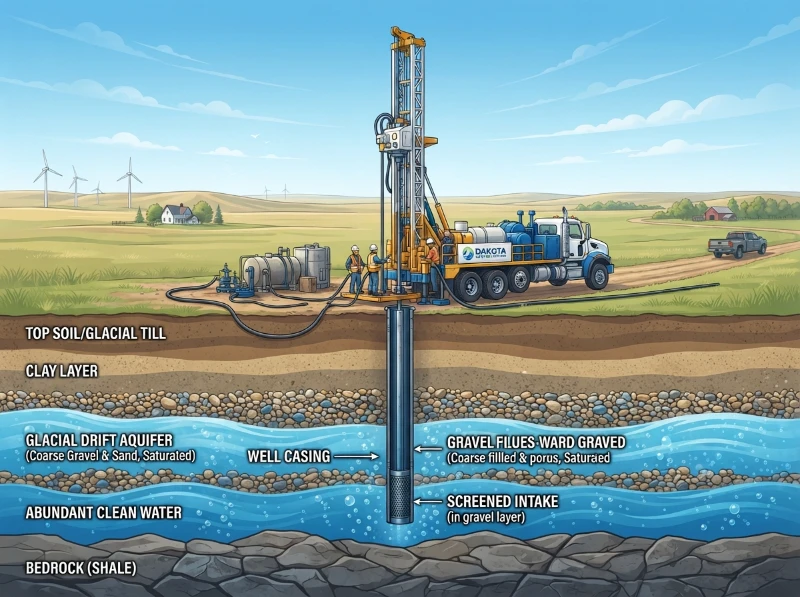
You have a concrete batch plant under construction in San Luis, and the municipal 2-inch line at the street cannot provide the flow rate necessary to fill your trucks. Or you are breaking ground on a manufacturing facility inside Yuma city limits that requires hundreds of gallons per minute for continuous cooling towers. When your commercial development outstrips the capabilities of the city grid, you must drill an industrial water well AZ relies on for massive, uninterrupted flow.
Industrial drilling is an entirely different discipline than punching a 5-inch hole for a homeowner. Commercial operations subject their water systems to brutal mechanical loads. The pumps run constantly. The vibration is extreme. If the well screen is improperly sized or the casing is structurally inadequate, the well will pump sand, machine the impellers off your expensive turbine pump, and shut down your entire operation. We execute commercial well drilling Yuma facility managers trust because we do not compromise on steel thickness, annular grout columns, or fluid engineering.
Navigating the Non-Exempt Well AZ Mandate
In Arizona, water is a highly protected resource. You cannot simply mobilize a rig on a commercial lot and start turning a tricone bit. The Arizona Department of Water Resources (ADWR) strictly regulates any well designed to pump more than 35 gallons per minute or intended for commercial use. These are classified legally as non-exempt wells.
Building a non-exempt well AZ state regulators approve requires navigating a wall of bureaucracy before we ever strike ground. Commercial wells in Active Management Areas (AMAs) or specific irrigation non-expansion areas are subject to strict grandfathered groundwater rights, Type 1 or Type 2 water rights, and stringent annual reporting. We assist commercial developers and facility managers in handling the technical specifics of ADWR permitting. We ensure the Notice of Intent (NOI) reflects the correct cadastral location, the intended industrial use, and the exact mechanical specifications of the proposed borehole. Once the legal path is cleared, we bring in the heavy iron.
Drilling in San Luis and Yuma City Limits
Executing an industrial drill within the city limits of San Luis or Yuma introduces a host of logistical hazards. We are not operating in an open agricultural field. We are navigating compacted fill dirt, buried utilities, concrete footings, and tight property lines. The geology remains unforgiving. We still must penetrate the heavy, collapsing alluvial gravels of the Colorado River basin while ensuring we do not undermine adjacent commercial structures.
To safely drill a 24-inch or 30-inch large-diameter borehole in a commercial zone, we run advanced direct mud rotary systems. A massive triplex mud pump forces a high-viscosity bentonite slurry down the drill string. This fluid hits the bottom of the hole at high velocity, lifting the cuttings back to the surface. Crucially, this heavy mud plasters the walls of the unconsolidated gravel beds, creating outward hydrostatic pressure. This prevents the massive borehole from collapsing inward, protecting both the drill string and the surrounding commercial real estate. Our mud engineers constantly monitor the Marsh funnel viscosity, adjusting the polymer mix in real-time as we chew through shifting geological lenses.
The Commercial Well Drilling Workflow
An industrial well is a massive piece of subsurface infrastructure. The mechanical execution must be flawless to guarantee decades of high-capacity performance.
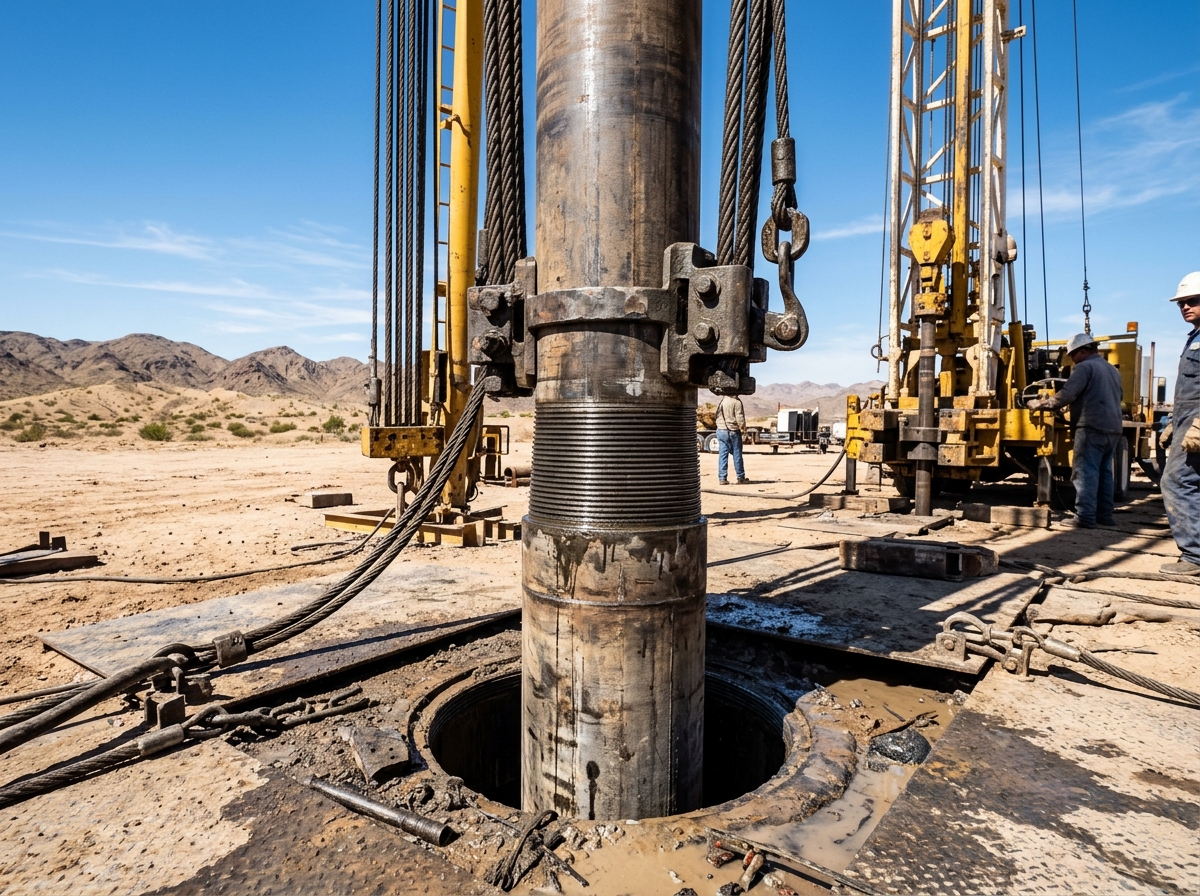
1. Geophysical E-Logging
Phase 01We do not guess where to place the intake screens. After advancing a pilot hole to the target depth, we run an electric log (E-log) down the open bore. This tool measures the electrical resistivity of the formation, allowing us to pinpoint the exact depth, thickness, and porosity of the strongest water-bearing sands and gravels. We design the casing and screen schedule precisely against this empirical data.
2. Heavy-Wall Steel Casing
Phase 02Unlike residential wells that use PVC, an industrial well requires heavy-wall carbon steel casing, often ranging from 10 inches to 24 inches in diameter. The lower sections consist of machine-slotted or wire-wrapped steel screens. The slot sizes are mathematically calculated based on the sand grain size retrieved during the pilot hole drilling, ensuring maximum water inflow while completely locking out native sediment.
3. Deep Sanitary Annular Seals
Phase 03Industrial zones carry a high risk of surface contamination—oil, heavy metals, and chemical runoff. ADWR mandates strict sanitary seals to protect the aquifer. We use a tremie pipe to pump a continuous column of neat cement or high-solids bentonite grout into the annular space between the steel casing and the borehole wall. For commercial wells in Yuma and San Luis, we often push this seal 50 feet or deeper to ensure zero surface water can track down the outside of the casing.
4. Aggressive Mechanical Development
Phase 04A freshly cased well is choked with drilling mud. We deploy dual-flange surge blocks on a wireline, violently plunging them up and down across the steel screens. This action shatters the mud cake and pulls the fine silts through the gravel pack. We then introduce high-pressure air, blowing the contaminated water out of the hole until it runs perfectly clear. Skipping this step destroys expensive commercial pumps. We do not skip steps.
Three-Phase Power and VFD Integration
Pulling hundreds of gallons a minute requires serious electrical force. We install heavy-duty submersible or lineshaft vertical turbine pumps designed specifically for the flow requirements of your facility. These motors require 480-volt, three-phase power.
Throwing full voltage across a 150-horsepower motor creates a violent torque spike that damages the pump and sends a destructive water hammer through your facility’s plumbing. To eliminate this, we integrate Variable Frequency Drives (VFDs) into our commercial installations. A VFD slowly ramps up the electrical frequency, providing a soft start that protects the mechanical components. It also allows your facility to dial in the exact GPM required at any given moment. If your cooling towers only need 50% flow overnight, the VFD slows the pump down, saving thousands of dollars in electrical overhead while maintaining perfect system pressure.
Demand Professional Execution
Your commercial development in Yuma County cannot afford a dry hole, an ADWR violation, or a pump that burns out in the middle of a production cycle. You need a Licensed & Insured contractor with the heavy iron and the engineering background to execute large-scale groundwater extraction.
Call Yuma Water Well Drilling at (928) 248-8305 to speak directly with an estimator for large-scale operations. We will review your site plans, discuss your target GPM requirements, and engineer an industrial water well AZ state law approves and your facility can depend on.
Engineering heavy industrial water wells and 480V 3-phase pump stations.
Commercial & Industrial Well FAQs
What classifies as a non-exempt well in AZ?
Under ADWR regulations, any well with a maximum pump capacity exceeding 35 gallons per minute (GPM) or intended for commercial, industrial, or heavy agricultural use is classified as a non-exempt well. These require specific permitting, grandfathered groundwater rights, and mandatory flow metering.
Can you drill an industrial water well inside Yuma city limits?
Yes. Drilling within Yuma and San Luis city limits is highly regulated but routine for our crews. It requires specialized municipal clearances, deep sanitary surface seals to prevent urban runoff contamination, and precise mud rotary execution to navigate buried infrastructure.
What size casing is used for commercial well drilling in Yuma?
Industrial and commercial water wells typically require heavy-wall carbon steel casing ranging from 10 to 24 inches in diameter, depending on the required GPM and the size of the three-phase turbine or submersible pump being installed.